
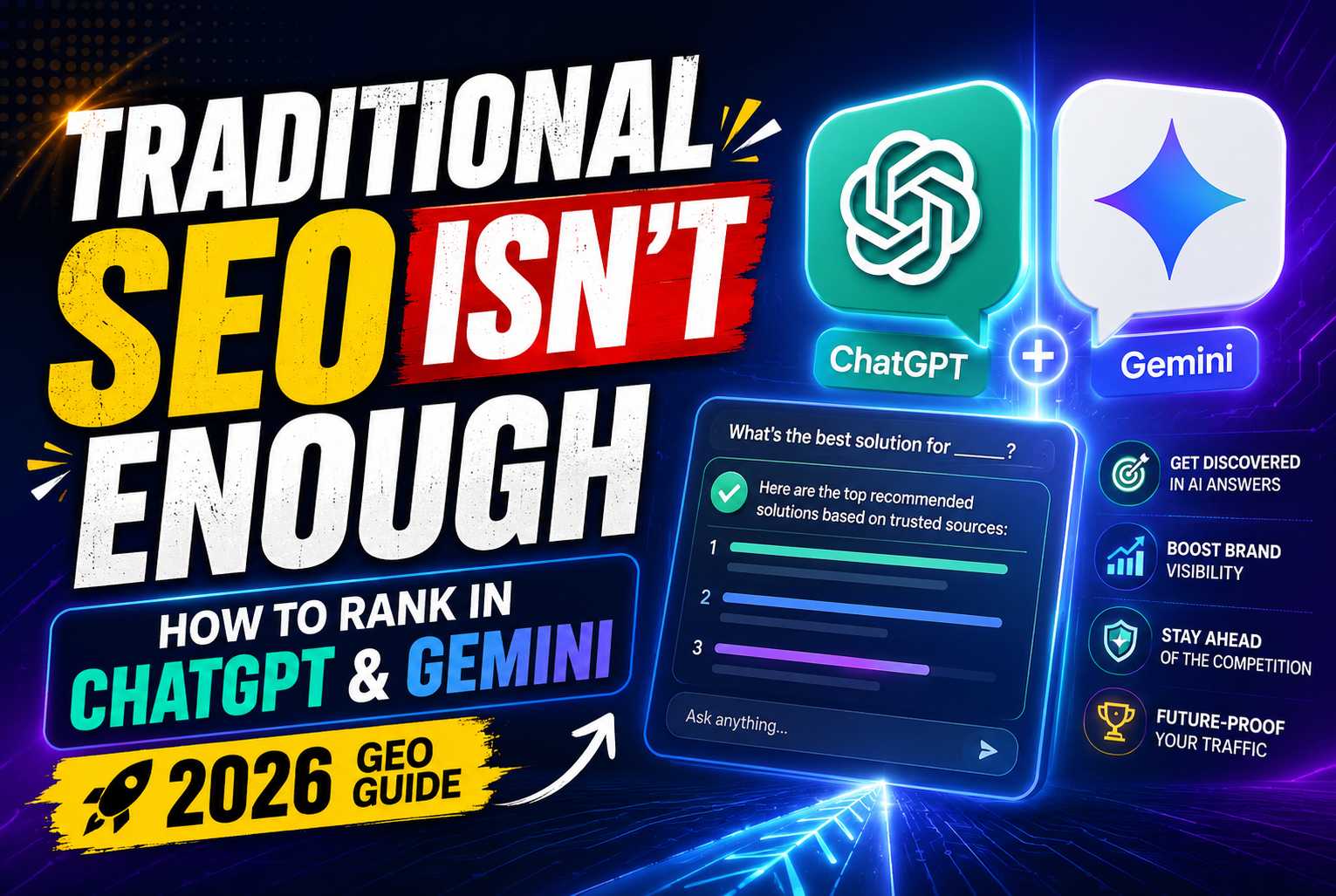
The digital landscape has fundamentally fractured. For over two decades, growing a business online followed a predictable playbook: target a keyword, build a backlink, and rank on page one of Google.
Today, the classic "10 blue links" model is fading fast.
Decision-makers, B2B buyers, and high-ticket enterprise clients are no longer scrolling through pages of search results. Instead, they are asking ChatGPT, Google Gemini, and Claude to summarize options and make direct brand recommendations. If a potential client asks an AI model for the top software development or digital marketing partners and your company isn't cited in the response, you simply do not exist to them.
To survive and capture inbound leads, your business must pivot from traditional Search Engine Optimization to an advanced Enterprise GEO strategy.
What is Generative Engine Optimization (GEO)?
Generative Engine Optimization (GEO) is the process of optimizing your digital footprint so that Large Language Models (LLMs) and search engine AI Overviews select, cite, and recommend your brand to users.
While traditional SEO focuses on algorithms that measure keyword density and domain authority, AI search optimization in 2026 relies on semantic context, structured facts, and relational trust across the entire web.
SEO vs. GEO: The Core Shift
| Optimization Metric | Traditional SEO | Generative Engine Optimization (GEO) |
| Primary Goal | Rank on Page 1 of Search Engines | Get cited as the direct answer by AI models |
| Target Mechanism | Crawler bots reading indexing keywords | LLM tokens parsing semantic meaning and context |
| Content Focus | Keyword frequency, length, and headings | Uncluttered facts, statistics, and domain authority |
| User Destination | Clicks directly to your website landing page | Direct consumption in the AI chat interface |
Why AI Search Optimization is Crucial for Hot Lead Generation
High-value enterprise clients rarely click on generic banner ads or informational blog posts. When a Chief Marketing Officer (CMO) or Chief Technology Officer (CTO) utilizes AI to solve a business problem, their search intent is highly specific and commercial.
Consider these high-intent user queries:
-
"Which digital marketing agency in Siliguri has the best track record for real estate lead generation?"
-
"Recommend reliable Generative Engine Optimization services in India for a mid-market SaaS platform."
When an AI engine processes these queries, it doesn't just guess. It scans the web for verified data points, structured reviews, and authoritative publications. By aligning your website with a dedicated Enterprise GEO strategy, you ensure that your business is the definitive solution packaged and delivered directly to that hot lead.
3 Reasons AI Models Are Ignoring Your Website Right Now
If your organic traffic is dropping despite consistent content publishing, your website likely suffers from technical roadblocks that prevent AI engines from utilizing your data.
1. Heavily Fragmented and Over-Stylized Layouts
AI bots require highly scannable, cleanly structured code to parse information effectively. Heavy, nested scripts, slow client-side rendering, and unoptimized page architectures create noise. If the core facts of your service pages are buried under complex layers of design elements, LLM web-crawlers will skip your site for an easier-to-read competitor.
2. A Lack of Extractable Facts and Verifiable Data
AI models prioritize content that contains high "information density." Generic, fluffy marketing language filled with buzzwords offers nothing for an LLM to anchor onto. To be cited by tools like Gemini, your content must include clear statistics, named case studies, clear step-by-step frameworks, and explicit technical answers.
3. Missing Schema Markup and Entity Relations
LLMs build relationships between "entities" (e.g., connecting a brand name to a specific service, location, or industry leader). If your website lacks comprehensive schema markup, search AI cannot accurately verify your business location, service offerings, or corporate identity.
Actionable Steps: How to Rank in ChatGPT and Gemini
Achieving top AI Overview visibility requires a proactive technical restructuring of your online assets.
Implement Advanced Schema and Structural Data
Speak the native language of search engines. Ensure every critical page uses highly detailed JSON-LD schema. Use Product schema for software applications, LocalBusiness schema for regional identity, and BlogPosting schema for insights. This organizes your data into clean, extractable packets for AI consumption.
Optimize for Citation Building
AI engines protect their credibility by citing sources. To become a source, restructure your content to feature concise, authoritative definitions at the top of your pages, followed by deeply researched supporting paragraphs. Use bolding strategically to emphasize key metrics and concrete conclusions.
Build a Multi-Platform Digital Footprint
ChatGPT and Gemini do not just read your website; they crawl third-party review platforms, industry forums, news outlets, and open-source directories. Cultivate high-quality mentions across independent platforms. Positive, verified feedback on external networks signals to AI models that your brand is a trusted market authority.
Maximize Your Brand's AI Visibility
The rules of online discovery have permanently changed. Waiting for traditional search rankings to return while AI engines absorb the market share is a losing strategy. To secure high-ticket clients, your business needs to be the name that AI models trust and recommend.
At EDVAC Technologies, we design future-proof digital architectures that bridge the gap between classic web presence and next-generation AI discovery.
Is your brand invisible to AI search? Don't lose high-value inbound prospects to competitors who adapted early. [Click Here to Get a Free, Custom GEO & AI-Visibility Audit for Your Business Today] and discover exactly how to position your company for the future of search.


(0) Comments:
Leave a Reply